
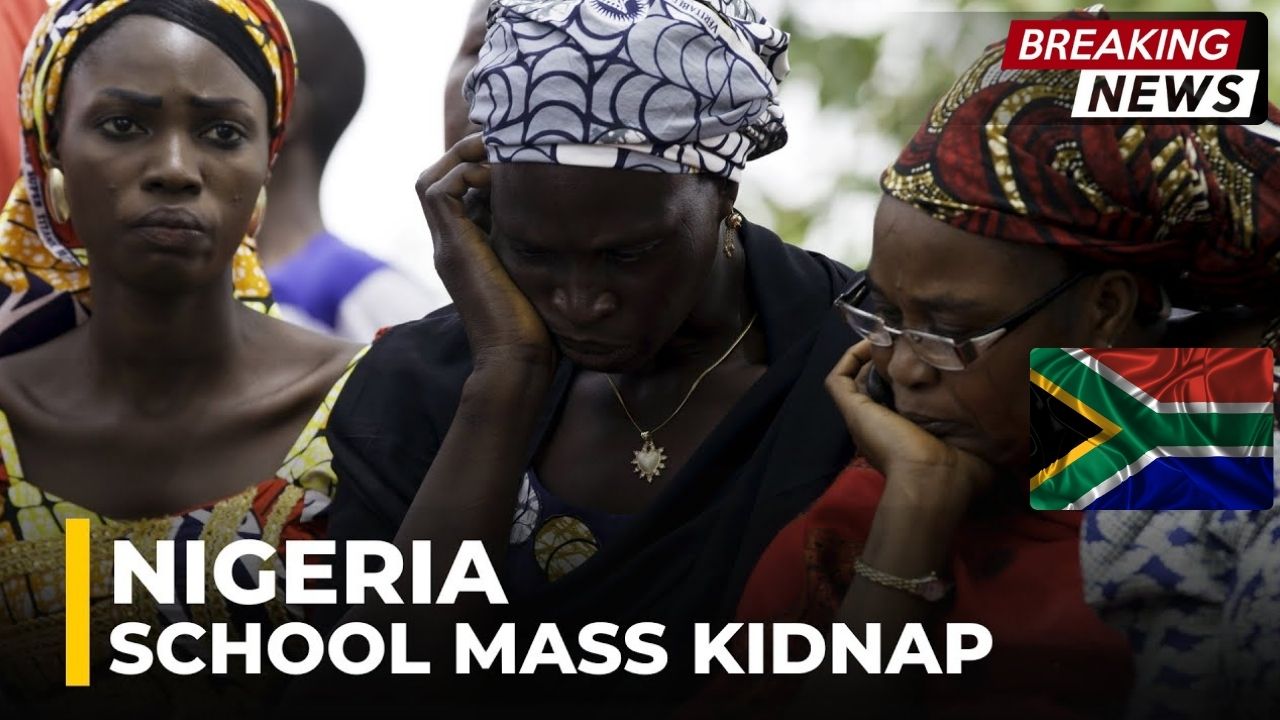
Another Mass Kidnapping Shocks Nigeria
Nigeria has once again been thrust into the global spotlight after yet another large scale school kidnapping. In the latest incident, gunmen stormed St Mary’s co educational school in Niger state and abducted more than 300 students and teachers in an early morning raid.
This mass abduction is the second such attack on a school in the same week, coming just days after 25 girls were seized from a secondary school in neighbouring Kebbi state. The two kidnappings, along with a deadly church attack in western Nigeria, underline the multiple security crises facing Africa’s most populous country.
Parents, religious leaders, and civil society groups are calling for urgent action, while authorities are closing schools in some northern and central states in a bid to prevent further attacks.
How The St Mary’s School Kidnapping Unfolded
The raid on St Mary’s took place in the early hours of Friday. Armed men invaded the school premises in Papiri, Niger state, and rounded up students and staff at gunpoint. The institution is a co educational Christian school with 629 enrolled students.
Initial reports suggested that a significant number of students had managed to escape into nearby bushland while the attackers marched others away. However, in the chaos that followed, families and authorities struggled to determine exactly how many people were missing.
As hours turned into a full day, more information began to emerge and the true scale of the abduction became clearer.
Quick Summary Of The Incident
Point |
Details |
|---|---|
Location |
St Mary’s co educational school, Niger state, central Nigeria |
Total Abducted |
315 people in total – 303 students and 12 teachers |
School Population |
629 students – almost half of the student body was taken |
Previous Incident This Week |
25 girls abducted from a secondary school in neighbouring Kebbi state |
Key Organisation Reporting |
Christian Association of Nigeria (CAN) |
Main Suspected Perpetrators |
Armed criminal gangs and bandits operating in northwest and central Nigeria |
Wider Security Context |
Longstanding insurgency and kidnappings linked to bandits and jihadist groups |
Official Site Link |
Revised Figures: 303 Students And 12 Teachers Taken
The Christian Association of Nigeria, known as CAN, played a central role in verifying the number of victims. After what it described as a detailed verification exercise, CAN announced that the total number of abducted persons stands at 315.
According to Reverend Bulus Dauwa Yohanna, the Catholic Bishop of Kontagora diocese, under which the school falls, the initial counts underestimated how many children had been taken. Some students who were first believed to have escaped were later confirmed missing.
He explained that:
- 303 students in total, both boys and girls, were kidnapped
- 12 teachers were also abducted, including 4 women and 8 men
- The combined total of 315 kidnapped individuals represents nearly half the school’s student population, plus a significant portion of its teaching staff
The updated tally shattered any remaining hope that the majority of students had fled safely.
Government Reaction And School Closures
While the Nigerian federal government has been slow to comment on the precise number of people abducted, local and state authorities have already begun to respond with emergency measures.
- In neighbouring states such as Katsina and Plateau, officials have ordered all schools to close temporarily as a precaution
- The Niger state government had already shut down many schools in areas considered highly vulnerable to attacks
- President Bola Tinubu reportedly cancelled planned international engagements, including attending the G20 summit in Johannesburg, to focus on the unfolding crisis
The closures reflect deep anxiety over the safety of pupils and teachers in regions where armed gangs and bandits operate with relative freedom.
A Country Haunted By Past School Kidnappings
Nigeria is still living with the trauma of previous mass abductions, most famously the kidnapping of nearly 300 schoolgirls from the town of Chibok in Borno state by Boko Haram jihadists more than ten years ago. Many of those girls are still unaccounted for, and the name Chibok has become a global symbol of the dangers facing Nigerian schoolchildren.
Since then, mass abductions for ransom have spread beyond jihadist strongholds in the northeast to other parts of the country. Schools are seen as soft targets where attackers can quickly seize large numbers of hostages, increasing pressure on families and authorities to pay ransoms.
The St Mary’s kidnapping fits into this grim pattern, reinforcing fears that schools remain dangerously exposed despite repeated promises of improved security.
Armed Gangs, Bandits, And Jihadists: A Complex Threat
The attackers responsible for many of these abductions are often described as bandits or heavily armed criminal gangs who operate across large swathes of rural northwest and central Nigeria. Their primary motivation is financial, particularly ransom collection.
These gangs:
- Maintain camps in large, difficult to access forests that span several states, including Zamfara, Katsina, Kaduna, Sokoto, Kebbi, and Niger
- Exploit the limited presence of state security forces in remote areas
- Frequently target villages, motorists, and schools in coordinated raids
A United Nations source has indicated that children kidnapped earlier in the week in Kebbi state were likely moved to the Birnin Gwari forest in Kaduna state, an area known as a stronghold for such groups.
While bandits are driven largely by money, security analysts warn that their growing cooperation with jihadist factions from the northeast is alarming. These alliances can strengthen logistical networks, provide weapons, and spread ideological influence, deepening instability across multiple regions.
Church Attack And Rising Religious Tensions
The same week that saw the two school abductions also witnessed a violent attack on a church in western Nigeria. Gunmen stormed a service that was being broadcast online, killing two people and reportedly abducting dozens of worshippers.
These incidents are occurring against a sensitive political and religious backdrop. The country has been under international scrutiny over violence against Christian communities, especially in areas where extremist elements are active.
Tensions have been further stoked by external commentary, including past threats of potential military action by foreign leaders in response to what they described as the killing of Christians by radical Islamist groups in Nigeria. Such statements have added pressure on the Nigerian government to be seen as decisive, even as it struggles to contain multiple security threats.
A Nationwide Hostage Crisis
Kidnapping for ransom has now become a widespread tactic across Nigeria. Victims include schoolchildren, clergy, traditional rulers, travellers, and ordinary villagers. Families are often forced to sell land, property, or livestock to raise ransom payments, while some communities collectively contribute to secure the release of abductees.
The combination of:
- Weak law enforcement in remote regions
- Limited economic opportunities
- Proliferation of weapons
- Long running insurgency in the northeast
has created an environment where criminal groups can thrive. As these gangs grow richer and better armed, they become bolder in their operations, targeting larger groups and more symbolic institutions like schools and churches.
Frequently Asked Questions
1. How many people were abducted from St Mary’s school in Niger state
According to the Christian Association of Nigeria, a total of 315 people were abducted, including 303 students and 12 teachers. This represents nearly half of the school’s student population.
2. Is this the only school kidnapping that happened recently in Nigeria
No. Earlier in the same week, gunmen abducted 25 girls from a secondary school in neighbouring Kebbi state. The St Mary’s incident is the second mass school kidnapping within a matter of days.
3. Who is believed to be behind these kidnappings
The attacks are widely attributed to heavily armed criminal gangs often called bandits, who operate across large rural areas of northwest and central Nigeria. These groups are primarily motivated by ransom money, though some have formed alliances with jihadist organisations.
4. How has the Nigerian government responded so far
Authorities in several states, including Katsina, Plateau, and parts of Niger, have ordered schools to close temporarily. President Bola Tinubu has cancelled some international engagements to focus on the crisis, and security forces are reportedly working to track the kidnappers and rescue the hostages.
5. Where can people find official information and updates about the situation
Official statements and updates are usually issued by the Nigerian federal government and relevant state governments. The central government’s main portal is available at https://nigeria.gov.ng, where key announcements and policy responses are published.
Conclusion: Mounting Pressure On Nigerian Authorities
The abduction of more than 300 students and teachers from St Mary’s co educational school is not just another statistic. It is a stark reminder that Nigeria’s security crisis is far from under control. Each new attack adds to public anger and despair, stretching trust in the capacity of the state to protect its citizens.
With schools closing, communities living in fear, and international attention once again focused on mass kidnappings, the Nigerian government faces intense pressure to deliver real results. That includes rescuing the hostages, dismantling bandit networks, and restoring confidence in education as a safe space for children.
Until systemic changes are made and security forces are strengthened and properly coordinated, families across the affected regions may continue to live with the fear that their children could be the next to vanish.
For More Information Click HERE