
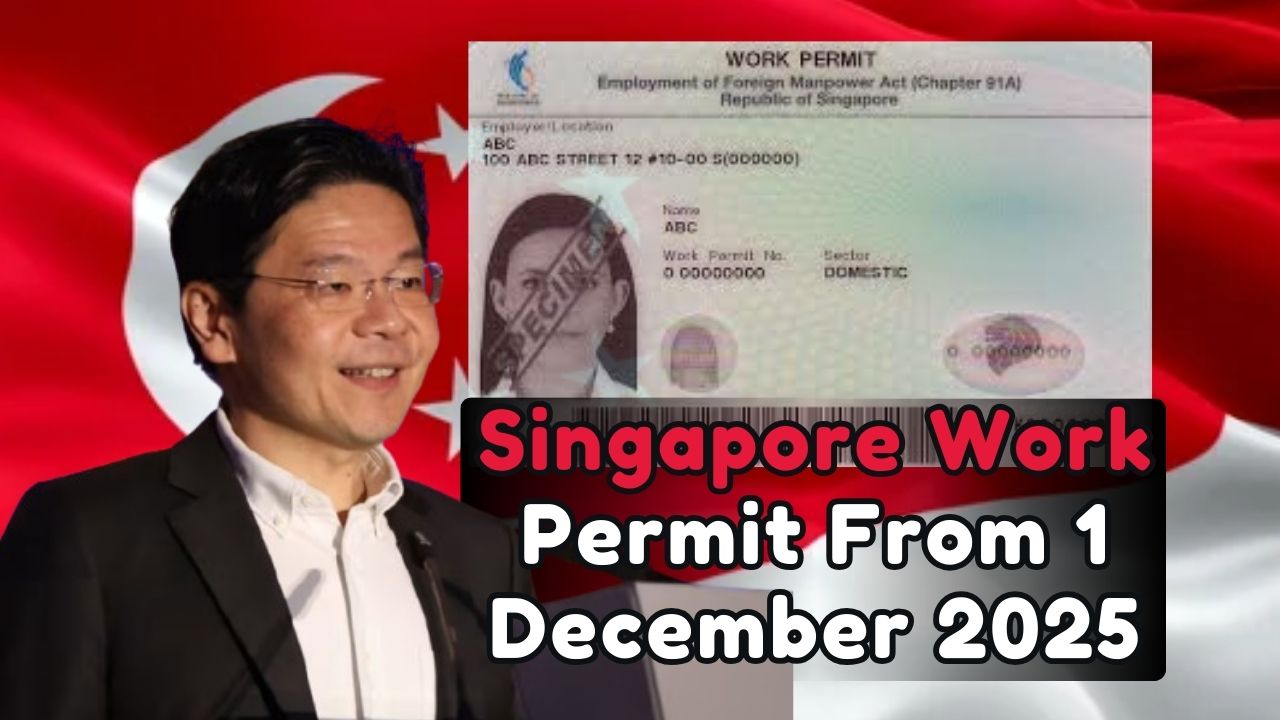
Singapore’s Work Permit framework is going through one of its biggest upgrades in 2025. From mid 2025 onward, Work Permit holders can stay longer with no fixed maximum employment period, benefit from higher age limits, and come from a broader list of approved source countries. At the same time, the Ministry of Manpower (MOM) is tightening quota and compliance rules and moving the entire system onto fully digital portals.
These changes are highly relevant for employers in construction, manufacturing, marine, process and services, as well as for foreign workers planning long term careers in Singapore. The reforms aim to balance foreign manpower needs with protection of local jobs, while using technology to make applications faster and more transparent.
Below is a complete breakdown of the new rules, costs, processes and benefits coming into effect in 2025 and fully in play by 1 December 2025.
Why Singapore Is Changing Work Permit Rules In 2025
The Work Permit system is designed for semi skilled migrant workers who fill manpower gaps that cannot be met by the local workforce. Sectors like construction and marine remain heavily dependent on foreign labour even as the government pushes for automation and upskilling.
In 2025, Singapore is dealing with several pressures at once: post pandemic labour shortages, an ageing population, and rising expectations on productivity and wages. To respond, MOM has announced reforms that:
- Remove rigid limits on how long a Work Permit holder can stay
- Raise the maximum age for foreign workers to continue contributing
- Open up more source countries to diversify labour supply
- Move fully to digital platforms for applications and renewals
- Tighten compliance, quota and levy enforcement for employers
The result is a framework that keeps Singapore competitive while still protecting local employment.
Quick Summary
Point |
Details |
|---|---|
Policy change year |
2025 (key measures effective from 1 July 2025) |
New maximum employment age |
Up to 63 years for Work Permit holders |
Age for new applicants |
Up to 61 years at point of application |
Maximum employment duration |
No fixed cap, renewals based on compliance and quotas |
New source countries |
Bhutan, Cambodia, Laos added to approved list |
Application mode |
Fully digital through MOM services such as WP Online and myMOM Portal |
Key sectors covered |
Construction, Manufacturing, Marine, Process, Services |
Official information |
Ministry of Manpower: https://www.mom.gov.sg |
Key Change 1: No More Maximum Employment Period
Previously, Work Permit holders were subject to lifetime caps that ranged roughly between 14 and 26 years depending on sector, skill and nationality. After the cap was reached, the worker could no longer continue on a Work Permit in Singapore.
From 1 July 2025 onward, this maximum employment period is abolished.
Instead of a fixed cap, continued employment will depend on:
- The employer staying within sector Dependency Ratio Ceilings (DRC) and levy rules
- The worker passing required medical checks
- Valid security bond and insurance coverage
- A clean compliance record for both employer and worker
This change lets employers retain experienced workers for longer, reducing frequent turnover and retraining costs. For workers, it creates a clearer long term pathway, provided they remain medically fit and employed by compliant companies.
Key Change 2: Higher Age Limits For Work Permit Holders
A major focus of the 2025 reforms is extending working lifespans for foreign workers, in line with Singapore’s broader move to higher retirement and re employment ages.
New limits include:
- Maximum employment age raised from 60 to 63 years for Work Permit holders
- Maximum age for new Work Permit applicants raised to 61 years, for both Malaysians and non Malaysians
These changes support continuity in sectors that rely on mature, skilled workers, and mirror national policy where older local employees are encouraged to remain in the workforce longer.
Key Change 3: Expanded Source Countries And Occupations
To reduce over dependence on a narrow set of sending countries, Singapore is widening its source country list. From 2025, additional approved countries include:
- Bhutan
- Cambodia
- Laos
These are added to traditional sources such as Bangladesh, China, India, Myanmar, the Philippines, Thailand and Vietnam.
In parallel, the Non Traditional Sources (NTS) Occupation List is being expanded to cover more roles, such as:
- Heavy vehicle drivers
- Certain manufacturing roles
- Cooks and related service occupations
Employers can therefore reach a broader pool of workers, although some NTS roles may attract higher levies and stricter quota treatment.
Digital First: Fully Online Work Permit Application And Renewal
A core part of the 2025 upgrade is end to end digitalisation. Applications, renewals, quota checks and many compliance processes now run through MOM’s online services, such as:
- WP Online eService
- myMOM Portal
- SGWorkPass mobile application for workers
Typical Digital Journey
- Quota and levy check
Employer logs into myMOM Portal or WP Online using CorpPass to confirm DRC and levy capacity. - Online application submission
Employer uploads passport details, job offer, any required qualifications and company documents. - In Principle Approval (IPA)
If eligible, MOM issues a digital IPA within a few working days for most straightforward cases. - Pre employment conditions
Worker completes medical examination, insurance, and any required security bond as set by MOM. - Biometrics and card issuance
Worker attends a MOM Services Centre appointment for photo and fingerprints. A physical card is issued, while a digital pass is visible immediately in SGWorkPass. - Renewals and cancellations
Renewals are submitted online, with salary and levy records checked electronically; cancellations similarly processed through the portals.
This digital shift reduces paperwork, speeds up processing and allows MOM to run automated checks on quotas, levies and employer history.
Sector Specific Quotas, Levies And Conditions
Even with more generous age and stay rules, foreign worker numbers are still controlled through Dependency Ratio Ceilings and levies. The exact percentages and levy tiers differ by sector, but the broad direction is:
- Construction and Marine: Higher DRC ceilings due to structural dependence on foreign labour
- Manufacturing and Process: Mid range DRC with emphasis on skills and technology adoption
- Services: Lower DRC, often around 35 percent, with higher levies for firms close to the limit
Employers must:
- Keep within DRC at all times or risk rejections for new or renewal applications
- Pay monthly levies on time, with higher rates for basic skilled tiers or NTS occupations
- Provide mandatory medical insurance and sector specific onboarding, such as safety training
Failure to comply can lead to fines, debarment from hiring Work Permit holders, or both.
Benefits For Employers And Workers
For Employers
- Ability to retain trained, experienced workers without a hard lifetime cap
- Lower recruitment and onboarding costs over time
- Greater flexibility to plan long term projects in manpower heavy sectors
For Workers
- Longer working horizon up to age 63, subject to fitness and employment
- More certainty if they are valued by compliant employers
- Clearer digital visibility of status through official apps
At the same time, MOM uses quotas, fair hiring rules and levies to ensure that local jobseekers remain the first priority.
How Employers And Workers Should Prepare
Employers should:
- Review DRC, levy exposure and workforce structure ahead of July 2025
- Update HR processes to fully use WP Online and myMOM Portal
- Budget for potential levy adjustments and rising wage expectations
- Strengthen record keeping, as digital audits and checks are becoming more frequent
Workers should:
- Ensure passports are valid for at least six months
- Keep medical records and any required qualifications ready
- Familiarise themselves with SGWorkPass and official MOM communications
Frequently Asked Questions On Singapore Work Permit 2025
1. What is the new maximum employment age for Work Permit holders in 2025?
A. From July 2025, the maximum employment age for Work Permit holders is raised to 63 years, subject to sector rules and medical fitness.
2. Is there still a lifetime cap on how long a Work Permit holder can work in Singapore?
A. No. The previous maximum employment period is removed. Renewals now depend on eligibility, quota space, levy and insurance compliance, and employer demand.
3. What is the age limit for new Work Permit applicants after the reforms?
A. New applicants generally can be hired up to age 61 at the time of application, for both Malaysians and non Malaysians, subject to MOM’s sector specific guidance.
4. Which new source countries are added under the 2025 Work Permit rules?
A. Bhutan, Cambodia and Laos are among the new source countries added to MOM’s approved list in 2025, alongside existing traditional sources in Asia.
5. Where can I find official details and apply for a Work Permit?
A. All official rules, forms and digital services are available on the Ministry of Manpower website at https://www.mom.gov.sg, through eServices such as WP Online and the myMOM Portal.
For More Information Click HERE