
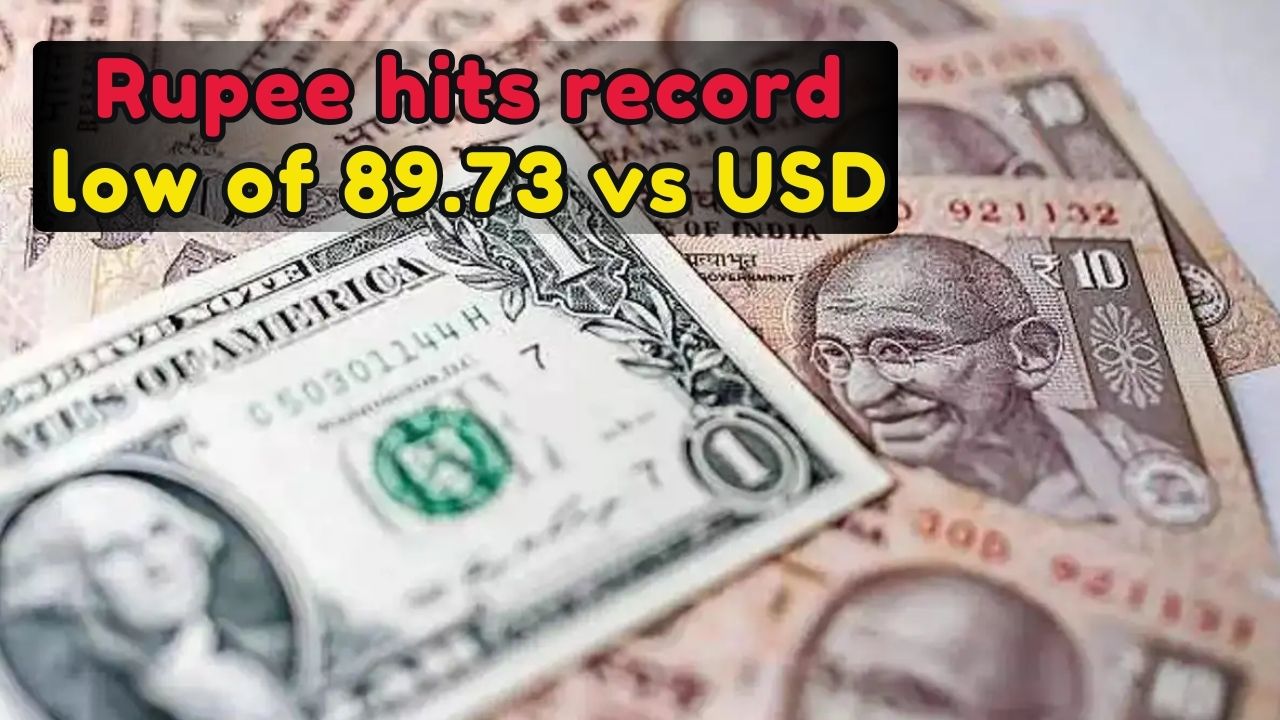
Rupee Falls To Lifetime Low Despite Strong GDP Data
The Indian rupee fell to a fresh record low of 89.73 against the US dollar on Monday. The move pushed the currency beyond its previous lifetime low of 89.49 that had been hit only about two weeks earlier.
What made the decline more striking is that it came immediately after India reported a far stronger than expected growth performance. The economy expanded by 8.2 percent in the September quarter, well above the 7.3 percent forecast in a Reuters poll. In most cases, such a robust growth print would support sentiment toward the domestic currency.
In this case, however, the positive growth surprise was overshadowed by persistent concerns over trade flows, portfolio investments, and the lack of progress on a long anticipated US India trade agreement.
Quick Summary Table
Key Detail |
Information |
|---|---|
New Record Low |
89.73 per US dollar |
Previous Record Low |
89.49 per US dollar |
Trigger Day |
Monday trading session |
Latest GDP Growth |
8.2 percent in September quarter |
Reuters GDP Poll Estimate |
7.3 percent |
Main Pressure Factors |
Weak trade and portfolio flows, stalled US India trade deal |
Foreign Equity Outflows 2025* |
Over 16 billion US dollars (net) |
Key Risk Highlighted |
Balance of payments turning less supportive |
Official Reference Site |
Why Strong Growth Is Not Helping The Rupee
Bankers and market participants pointed out that the rupee is caught in a difficult macro environment. On the one hand, economic growth is strong. On the other, external sector pressures have intensified.
Several factors are weighing on the currency:
- Long running weakness in merchandise trade
- Unfavourable portfolio investment flows into equities
- Delay in finalising a US India trade deal
- A balance of payments position that has turned less supportive
Importers have been active in hedging their future dollar requirements, which has added to dollar demand in the market. At the same time, foreign portfolio investors have been net sellers of Indian equities over the year, pulling out more than 16 billion US dollars. This combination has limited the ability of strong GDP data to provide meaningful support to the rupee.
Role Of Non Deliverable Forwards And State Run Banks
Traders noted that Monday’s sharp move was also influenced by technical and derivatives related factors. The maturity of positions in the offshore non deliverable forwards market added pressure on the rupee during the session.
Non deliverable forwards are a popular tool for offshore investors who want to take positions on the rupee without directly accessing onshore markets. When large positions mature or are rolled over, they can temporarily increase volatility in the spot market.
Market participants also observed that state run banks were intermittently seen offering US dollars. This is often interpreted as a sign of potential central bank presence or at least an effort to smooth disorderly market moves, although such interventions are rarely confirmed in real time.
J P Morgan: Calibrated Depreciation Seen As Inevitable
Economists at J P Morgan characterised the current trend as a calibrated depreciation of the rupee that is both inevitable and desirable given the macro backdrop. In their view, the longer the US India trade deal remains stalled, the more the rupee will be required to adjust in order to absorb part of the external pressure.
In simple terms, a weaker rupee can help partially offset competitiveness losses that arise from trade barriers or weaker export demand. However, such depreciation also raises concerns around imported inflation, especially for energy and other essential commodities that India buys from abroad.
Trade Deal Delay And Tariff Concerns
Expectations around a potential US India trade agreement had risen last month after comments from officials on both sides suggested that steep tariffs could be reduced. In particular, there was hope that some duties as high as 50 percent on Indian exports might be eased.
So far, these expectations have not translated into a concrete deal. The lack of clarity has weighed on sentiment, with investors turning cautious about future export prospects and market access.
High tariffs have affected both trade flows and portfolio inflows. Equity investors are wary of the impact that prolonged trade frictions could have on corporate earnings and export led sectors. As a result, the rupee has become more reliant on periodic central bank support rather than natural inflows.
Balance Of Payments Turning Less Supportive
The balance of payments, which captures all cross border transactions including trade, investments, and remittances, has become less supportive for the rupee.
Key pressure points include:
- Wider trade deficit due to strong import demand and volatile commodity prices
- Net equity outflows from foreign investors
- Reduced cushion from earlier periods of strong inflows
While services exports and remittance flows remain resilient, they have not fully offset the drag from goods trade and portfolio outflows. This shift in the balance of payments profile has made the currency more vulnerable to external shocks and global risk sentiment.
Government And Central Bank Response
Although the article highlights that state run banks have been active in the foreign exchange market, there is no official confirmation of direct intervention levels. Typically, the Reserve Bank of India focuses on containing excessive volatility rather than defending any particular exchange rate.
Authorities are likely to emphasise the underlying strength of the Indian economy, pointing to the 8.2 percent GDP growth figure as evidence of resilience. At the same time, they may prefer a gradual and orderly adjustment in the rupee rather than abrupt one way moves.
What This Means For Businesses And Individuals
A weaker rupee has mixed implications:
- Importers face higher costs, especially for fuel, raw materials, and capital goods priced in dollars.
- Exporters may gain some competitiveness in global markets, although tariff barriers and global demand conditions still matter.
- Tourists and students planning overseas travel or education will see higher rupee costs for dollar expenses.
- Investors need to factor in currency risk when investing in foreign assets or when foreign investors evaluate Indian markets.
For policy makers, the immediate challenge is to balance growth support with financial stability and inflation control in a context of global uncertainty.
Frequently Asked Questions
1. What is the new record low for the Indian rupee against the US dollar
The rupee touched a new lifetime low of 89.73 per US dollar.
2. Why did the rupee fall even after strong GDP growth data
Despite 8.2 percent GDP growth in the September quarter, the rupee is under pressure from weak trade flows, foreign portfolio outflows, importer hedging, and the lack of progress on a US India trade deal.
3. How much have foreign investors sold in Indian equities this year
Foreign investors have been net sellers of more than 16 billion US dollars in Indian equities so far this year.
4. What role does the Sanchar Saathi or other government schemes play in this context
The rupee movement discussed here is primarily linked to trade flows, portfolio investments, and external balances. Government digital initiatives are not central to this particular currency move.
5. Is rupee depreciation always negative for the economy
Not necessarily. A controlled or calibrated depreciation can help exports and adjust to external shocks. However, excessive or disorderly weakness can fuel imported inflation and hurt investor confidence.
Conclusion
The slide of the Indian rupee to a record low of 89.73 per US dollar highlights the complex interplay between strong domestic growth and rising external pressures. While India’s economic expansion remains robust, unresolved trade issues, portfolio outflows, and a less supportive balance of payments have combined to outweigh the positive impact of the upbeat GDP print.
Until there is clearer progress on trade negotiations and a revival in foreign flows, the rupee is likely to remain sensitive to global risk sentiment and macro data, with policymakers walking a careful line between allowing necessary adjustment and guarding against instability.
For More Information Click HERE